Circular Economy Hub, operated by Artiql, has rebranded “Circular X,” its monthly online learning program running since 2021 that explores how the circular economy might expand across industries and fields, as “Refuturing.” The series continues every month as a space for dialogue on reimagining the future.
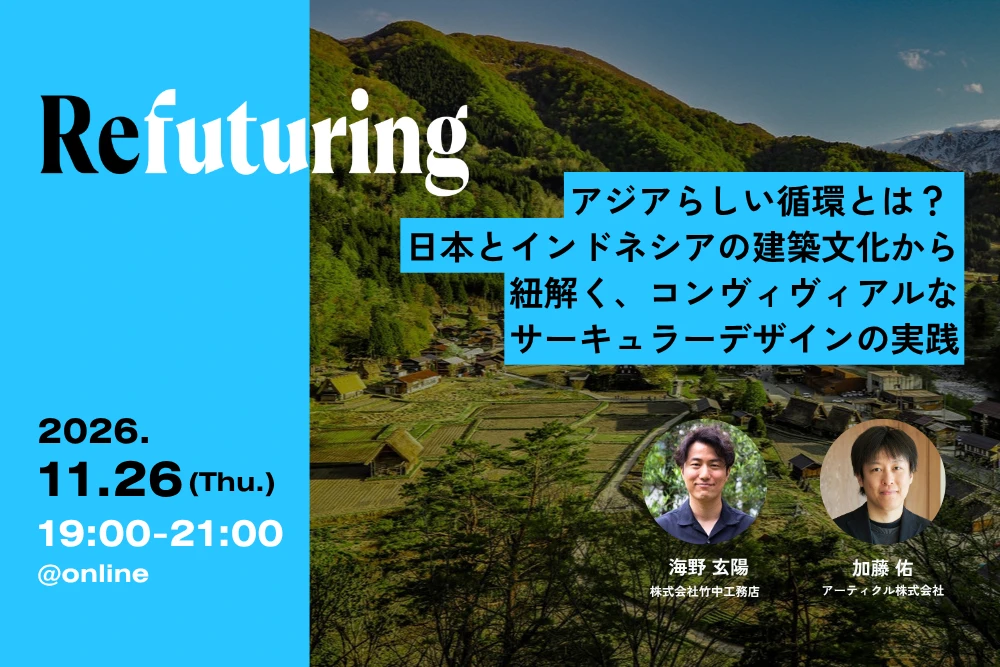
The theme for November is “What does a distinctly Asian approach to circularity look like? Convivial circular design in practice, seen through Japanese and Indonesian architectural cultures.”
What does a distinctly Asian approach to circularity look like? Convivial circular design in practice, seen through Japanese and Indonesian architectural cultures
The circular economy has spread mainly from Europe and is now taking root widely in Japan as well. In Europe, a range of frameworks and principles has been developed to put this new socioeconomic system into practice. Among them is the butterfly diagram, drawn up by the Ellen MacArthur Foundation and based on the Cradle to Cradle concept. It separates the biological cycle, in which materials return to the soil, from the technical cycle, which keeps finite technical materials such as petroleum and metals in circulation.
Can these frameworks and principles be applied as they are in a region like Japan, whose climate, culture, and history differ from Europe’s? What natural conditions and cultural assumptions, often held unconsciously, underlie concepts developed elsewhere? While learning from leading European practice, how can we envision a circular future that is distinctively Japanese and Asian?
The November session features Genki Unno of Takenaka Corporation, who works on research and practice in circular design and circular architecture in the company’s design department. Comparing architectural cultures in Europe and Asia (Japan and Indonesia), the session will explore the potential of circular design suited to Japan.
It will cover Takenaka’s circular architecture initiatives, which Unno and his colleagues are driving, along with insights from their visit to Indonesia in 2026. Drawing on case studies, the session will examine concrete methods of place-based circular design that fosters a convivial relationship between people and nature. If you are interested in how to realize circularity that is distinctively Asian and Japanese in business and urban development, beyond ideas and philosophy, we invite you to join.
Speakers: Genki Unno (Takenaka Corporation) and Yu Kato (Founder, IDEAS FOR GOOD / CEO, Artiql Inc.). The session will take place online on Thursday, November 26, from 19:00 to 21:00 JST, and will be conducted in Japanese.
Topics for the session
- Takenaka’s “Circular Model 2050” and “Circular Design-Build®” (both in Japanese)
- Differences in architectural styles between Europe and Asia (Japan and Indonesia)
- A culture of stone and a culture of biomass
- Revisiting the butterfly diagram from a cultural perspective
- Curbing entropy and harvesting value through cycles in the biosphere
- Will modular design for circular systems raise the value of cities?
- Designing for redundancy, and a democratic circular economy driven by local communities
- Convivial technology and designing building lifespans
* This event is linked to two articles in IDEAS FOR GOOD, a sister publication of Circular Economy Hub. Both articles are in Japanese. We recommend reading them beforehand (see the related articles below).
Keywords related to this event
This event will be of particular interest to those following these themes.
#Circular design #Architecture #Culture #Design #Urban development #Cities #Butterfly diagram #Biomass #Bamboo #Timber #Japan #Indonesia #Conviviality #Vernacular #Local communities #Community #Citizen participation
About the Refuturing event series
A monthly event series developed by Circular Economy Hub. The series invites thought leaders and practitioners who are driving the transition toward a sustainable circular future, exploring new ways of circular design that question linear growth narratives from diverse perspectives and reweave relationships between humans and nature, as well as between the present and the future.
* What is Refuturing? Climate change, conflict, and other intertwined crises are compounding into a polycrisis, and existing economic and social systems, institutions, and values are taking a sustainable future away from us, a condition described as “Defuturing.” Refuturing refers to a way of thinking and practice that questions these systems, institutions, and values at their foundations, repairs relationships between people and the world, and reconstructs alternative futures that might have been, or more desirable ones.
Organizer: Circular Economy Hub
Circular Economy Hub is a specialist media and platform dedicated to the circular economy, operated by Artiql. It provides the latest trends, case studies, insights, events, and workshops related to the circular economy both in Japan and globally. Drawing on the expertise of its editorial team in Japan and around the world, along with its networks and hands-on experience, it supports companies and municipalities in advancing circular design, circular business, and the transition to circular cities.
URL: https://cehub.jp/en/
Support for circular city transition for municipalities by Circular Economy Hub
- Circular City Transition Guide (in Japanese)
- Circular City Transition Index (in Japanese)
Event details and registration
Event details and registration: https://refuturing10.peatix.com/ (in Japanese)
Related articles (IDEAS FOR GOOD, in Japanese):