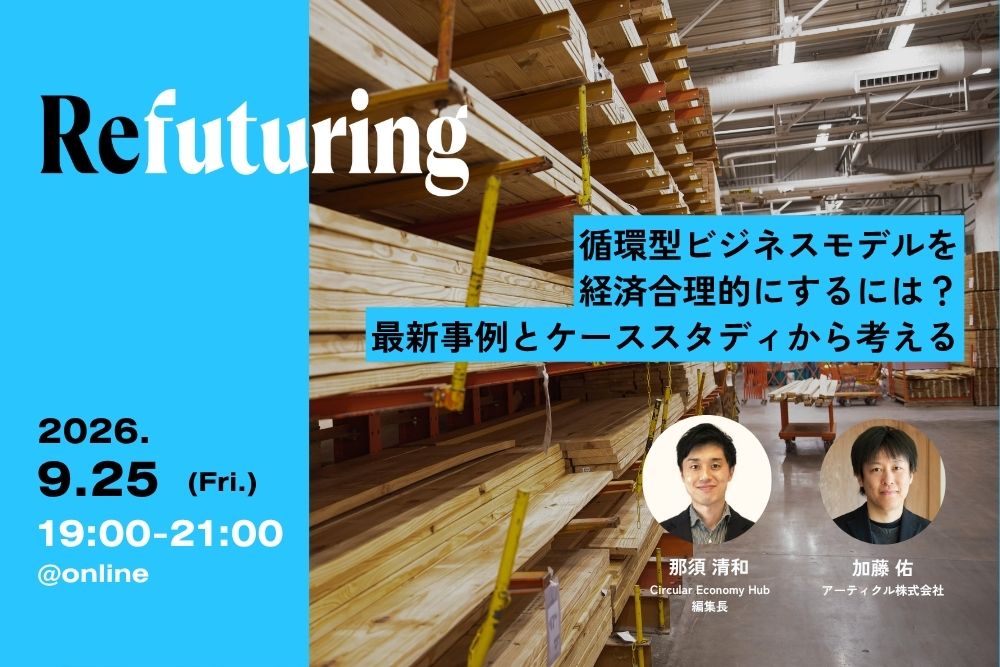
Circular Economy Hub, operated by Artiql, has rebranded “Circular X,” its monthly online learning program running since 2021 that explores how the circular economy might expand across industries and fields, as “Refuturing.” The series continues on a monthly basis as a space for dialogue about reimagining the future.
The theme for September is “How can we make circular business models economically rational? Learning from recent examples and case studies.”
How can we make circular business models economically rational? Learning from recent examples and case studies
Many companies working to transition to a circular economy continue to run into the same obstacle: economic viability. In recent years, a string of unsettling headlines has driven the point home: the sale of the U.S.-based sustainable footwear brand “Allbirds,” the liquidation of Sinny & Ooko, the operator of the Paris-based circular complex “La REcyclerie,” and the bankruptcy of the Dutch circular-denim brand “MUD JEANS,” long held up as a flagship example of circular business models. Of course, not all of these outcomes stem from the inherent difficulty of circular business models, but building an economically rational one within today’s linear economic and social system is never easy.
Moreover, making the circular economy an economically rational choice compared to the linear economy requires collaboration between companies and industries, including between forward, arterial industries and reverse, venous industries, as well as cross-sector collaboration spanning regulation, technological innovation, and changes in consumer lifestyles. How can companies overcome these many constraints to build circular businesses that are also economically sustainable? This session of Refuturing will tackle the question head-on, introducing the latest overseas business model examples and case studies as participants explore possible answers together.
Specifically, the session will survey common types of circular business models, the challenges already emerging in practice, and the structural reasons behind them, before introducing concrete solutions alongside case studies. While focusing on business models, it will also touch on a wide range of related themes underpinning their economic sustainability, including regulation, circular finance, circular accounting, and the creation of a circular culture.
Registration for this session is open now. Please note that the session itself will be conducted in Japanese.
▶️ Event details & registration: https://refuturing08.peatix.com/ (in Japanese)
Keywords related to this event
This event is highly recommended for those interested in the following keywords.
#Circular economy #Circular business model #PaaS #Sharing #Recycled material #Circular finance #Circular accounting #Cost #Value #Culture creation #Arterial venous collaboration #Cross sector collaboration
About the Refuturing event series
A monthly event series developed by Circular Economy Hub. The series invites thought leaders and practitioners who are driving the transition toward a sustainable circular future, exploring new ways of circular design that question linear growth narratives from diverse perspectives and reweave relationships between humans and nature, as well as between the present and the future.
* What is Refuturing? As challenges such as climate change and resource constraints intensify, there is growing concern that current social systems may be limiting the possibilities of future generations. This situation is sometimes described as “Defuturing.” Refuturing refers to a way of thinking and practice that questions the underlying assumptions of existing economic and social systems, institutions, and values that diminish the future, while repairing relationships between people and the world and reconstructing alternative and more desirable futures.
Organizer: Circular Economy Hub
Circular Economy Hub is a specialized media platform on the circular economy operated by Artiql. It provides the latest trends, case studies, insights, events, and workshops related to the circular economy both in Japan and globally. Through the expertise of its editorial team located in Japan and around the world, as well as its networks and practical experience, it supports companies and municipalities in advancing circular design, circular business, and the transition to circular cities.
URL: https://cehub.jp (in Japanese)
Support for circular city transition for municipalities by Circular Economy Hub
- Circular City Transition Guide: Circular city transition guide (in Japanese)
- Circular City Transition Indicator: Circular city transition indicator (in Japanese)