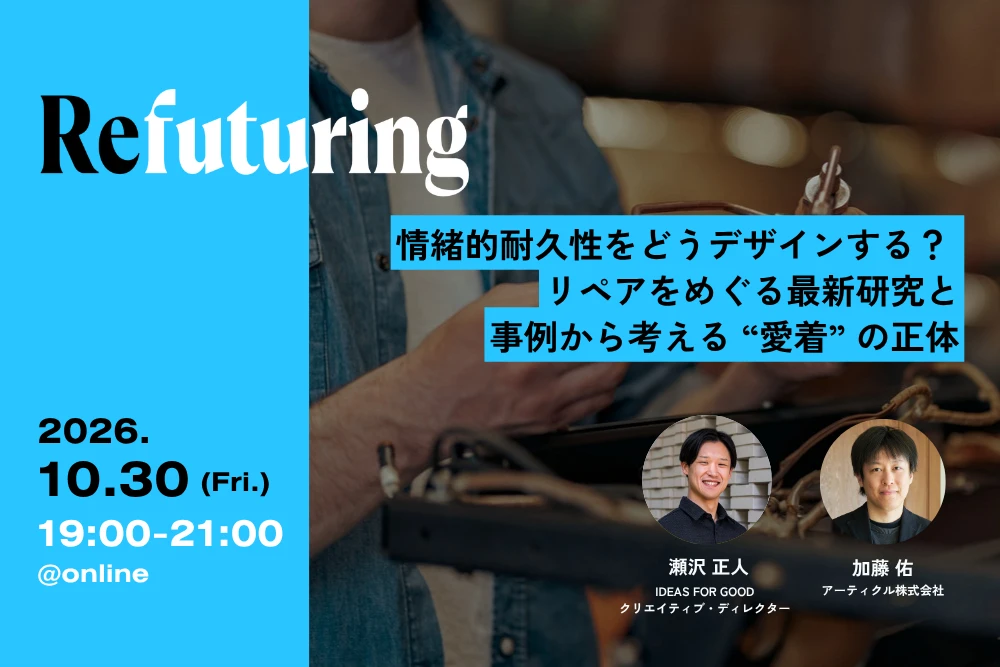
Circular Economy Hub, operated by Artiql, has rebranded “Circular X,” its monthly online learning program running since 2021 that explores how the circular economy might expand across industries and fields, as “Refuturing.” The series continues on a monthly basis as a space for dialogue about reimagining the future.
The theme for October is “How can we design for emotional durability? What the latest research and examples of repair reveal about attachment.”
How can we design for emotional durability? What the latest research and examples of repair reveal about attachment
What makes us treasure a product, use it for years, and repair it when it breaks? One concept long discussed in sustainable design and circular design is “emotional durability.” Rather than asking how physically durable a product is, it asks how long a user can sustain an emotional connection with it. In other words, it locates durability not in the product itself but in the relationship between the product and its user.
The concept was set out by British design researcher Jonathan Chapman in his 2005 book “Emotionally Durable Design: Objects, Experiences and Empathy.” In 2018, a research team including Chapman published the paper “Emotional Durability Design Nine: A Tool for Product Longevity,” which organizes the approach into nine themes (relationships, narratives, identity, imagination, conversations, consciousness, integrity, materiality, and evolvability) and 38 strategies, turning the concept into a practical design method.
Emotional durability is closely tied to the desire to repair, so it bears on two growing priorities in the circular economy: making repair more widespread and realizing the Right to Repair.
The October session takes place online on October 30. It features Masato Sezawa, director of the IDEAS FOR GOOD original documentary “The Repair Cafe” (website in Japanese), which follows the repair café movement that began in Amsterdam. Sezawa lives in Amsterdam and knows the repair scene across Europe well. Yu Kato, founder of IDEAS FOR GOOD, will also speak in both the talk and the panel discussion.
Drawing on a survey of the documentary’s viewers about emotional durability, together with the latest research and practical examples from Japan and abroad, the session will explore the following topics.
Topics for the session
- What is emotional durability (emotionally durable design)?
- Design for emotional durability
- How can emotional durability be strengthened? (Themes and strategies)
- How do strategies for emotional durability differ by product category?
- Challenges and dilemmas in designing for emotional durability
- Differences between European and Japanese approaches to emotional durability
- Emotional durability from the perspectives of repair and care
* Related article: Circular Economy Hub, “Why emotional durability matters for extending product lifetimes, and six design strategies” (in Japanese)
Speakers: Yu Kato (Founder, IDEAS FOR GOOD / CEO, Artiql Inc.) and Masato Sezawa (Creative Director, IDEAS FOR GOOD / Director, “The Repair Cafe”)
Date and time: Friday, October 30, 2026, 19:00–21:00 JST (doors open 18:50) | Online (Zoom) | Capacity: 30 participants (first come, first served)
Registration is now open. Please note that the session will be conducted in Japanese.
▶️ Event details and registration: https://refuturing09.peatix.com/ (in Japanese)
Keywords related to this event
This event is highly recommended for those interested in the following keywords.
#Sustainable design #Circular design #Emotional durability #Repair #Repair café #Right to Repair #Circular product design #Circular service design #Relational design #Care #Japanese culture
About the Refuturing event series
A monthly event series developed by Circular Economy Hub. The series invites thought leaders and practitioners who are driving the transition toward a sustainable circular future, exploring new ways of circular design that question linear growth narratives from diverse perspectives and reweave relationships between humans and nature, as well as between the present and the future.
* What is Refuturing? As challenges such as climate change and resource constraints intensify, there is growing concern that current social systems may be limiting the possibilities of future generations. This situation is sometimes described as “Defuturing.” Refuturing refers to a way of thinking and practice that questions the underlying assumptions of existing economic and social systems, institutions, and values that diminish the future, while repairing relationships between people and the world and reconstructing alternative and more desirable futures.
Organizer: Circular Economy Hub
Circular Economy Hub is a specialized media platform on the circular economy operated by Artiql. It provides the latest trends, case studies, insights, events, and workshops related to the circular economy both in Japan and globally. Through the expertise of its editorial team located in Japan and around the world, as well as its networks and practical experience, it supports companies and municipalities in advancing circular design, circular business, and the transition to circular cities.
URL: https://cehub.jp (in Japanese)
Support for circular city transition for municipalities by Circular Economy Hub
- Circular City Transition Guide: Circular city transition guide (in Japanese)
- Circular City Transition Indicator: Circular city transition indicator (in Japanese)