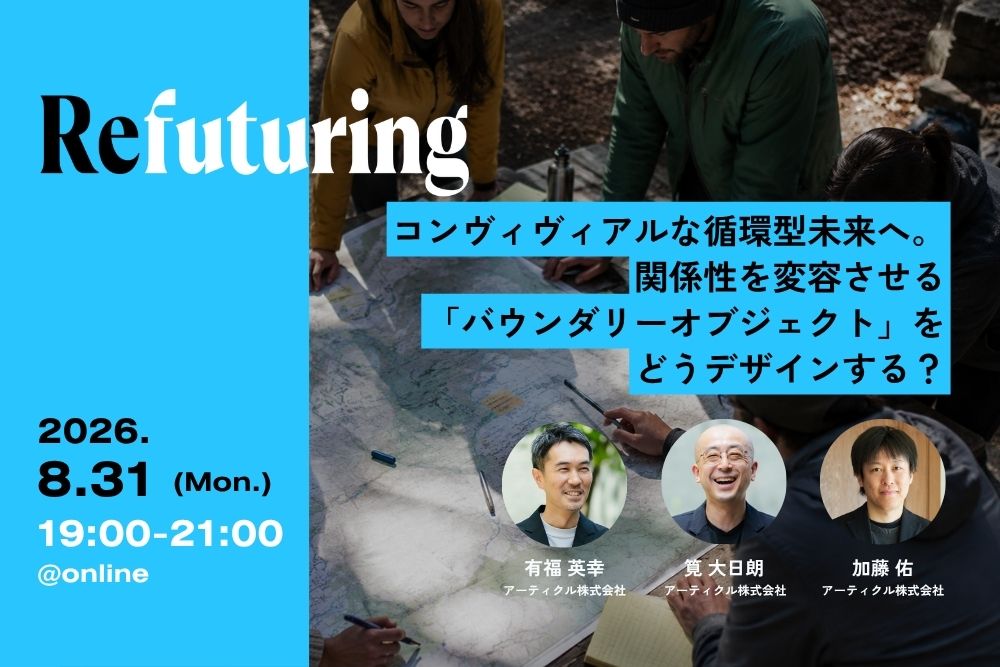
Circular Economy Hub, operated by Artiql, has rebranded its online learning program “Circular X,” which has been held every month since 2021 to explore visions of a future in which the circular economy expands across industries and fields, as “Refuturing.” The program continues as a new series, held monthly as a space for dialogue to reimagine the future.
The theme for August was “Toward a convivial circular future. How do we design boundary objects that transform relationships?”
Toward a convivial circular future. How do we design “boundary objects” that transform relationships?
Realizing the circular economy requires designing “partnerships,” such as collaboration between forward, arterial industries and reverse, venous industries to build circular value chains, and cross sector collaboration spanning industry, government, academia, and citizens. However, connecting with diverse stakeholders who differ in organizational purpose, timeframe, language, and interests, and building co creative relationships that are not zero sum, is never easy.
How can we build convivial partnerships in which individuals remain autonomous while supporting one another and thriving together, in order to realize a vision of a sustainable circular future? And how can we transform the relationships among different stakeholders to make such partnerships possible? This is where the concept of “boundary objects” offers a useful hint.
The concept of the boundary object was proposed in a paper in 1989 by sociologists Susan Leigh Star and James Griesemer. It refers to an object that exists across different social worlds, such as specialized fields, departments, or positions, and that combines enough “plasticity” to be interpreted according to the needs of each context with enough “robustness” to be recognized as the same object across every context. A boundary object is a medium that enables collaboration among people who do not share a complete common definition or understanding, ranging from abstract things such as concepts and data dashboards to concrete things such as prototypes.
This session of Refuturing revisited the concept of the circular economy and the practice of circular design from the perspective of boundary objects. By treating relationships, an invisible thing, rather than visible things such as materials and products, as an object of design, participants explored together how it is possible to enable collaboration among different stakeholders and realize a circular economy that creates environmental and social impact while also being economically rational.
On the day of the event, the Circular Economy Hub editorial team introduced recent international papers on the circular economy that focus on the concepts of conviviality, relationships, and boundary objects, along with the value of boundary objects that the team has experienced firsthand through collaborative projects with companies and municipalities, and concrete case studies from Japan and abroad. Through these, the session translated abstract concepts into practical frameworks and know how that could be put to use in daily work.
Keywords related to this event
This event was highly recommended for those interested in the following keywords.
#Circular practitioner #Circular economy #Cross sector collaboration #Arterial venous collaboration #Regional relational capital #Boundary object #Conviviality #Circular design #Commons
About the Refuturing event series
A monthly event series developed by Circular Economy Hub. The series invites thought leaders and practitioners who are driving the transition toward a sustainable circular future, exploring new ways of circular design that question linear growth narratives from diverse perspectives and reweave relationships between humans and nature, as well as between the present and the future. * What is Refuturing? As challenges such as climate change and resource constraints intensify, there is growing concern that current social systems may be limiting the possibilities of future generations. This situation is sometimes described as “Defuturing.” Refuturing refers to a way of thinking and practice that questions the underlying assumptions of existing economic and social systems, institutions, and values that diminish the future, while repairing relationships between people and the world and reconstructing alternative and more desirable futures.
Organizer: Circular Economy Hub
Circular Economy Hub is a specialized media platform on the circular economy operated by Harch. It provides the latest trends, case studies, insights, events, and workshops related to the circular economy both in Japan and globally. Through the expertise of its editorial team located in Japan and around the world, as well as its networks and practical experience, it supports companies and municipalities in advancing circular design, circular business, and the transition to circular cities. URL: https://cehub.jp (in Japanese)
Support for circular city transition for municipalities by Circular Economy Hub
- Circular City Transition Guide: Circular city transition guide (in Japanese)
- Circular City Transition Indicator: Circular city transition indicator (in Japanese)
For more information
https://cehub.jp/event/refuturing-7/ (in Japanese)