Circular Economy Hub Japan, the English edition of Circular Economy Hub operated by Artiql, has redesigned its site and added new features for members, including an annual billing option for Reader membership. The main updates are as follows.
Website redesign
We refreshed the site’s design to make articles easier to read and to improve the experience on smartphones. New features include a text-size toggle and dark mode (top right of the screen), a choice between card and list views for article listings, and a save-for-later feature that lets you build a reading list with a single click, useful for sharing internally with your team.
Circular Tool Box launched
We have launched Circular Tool Box, a growing set of data tools for people working on circular business, city policy and design in Japan. Free readers can see part of each tool; Reader members get full access. We add to the set as new data becomes available.
- Circular Startup Map: Japan, mapping Japan’s circular economy startups across the five circular business models
- Circular Economy Stock Tracker, tracking share prices and financial indicators for listed companies working on the circular economy (members only)
Other updates
- Expanded our Circular Learning Hub, gathering recommended courses, podcasts and books on the circular economy in one place
- Launched this site, Circular Economy Hub Japan, to bring our coverage of Japan’s circular economy news, policy and data to readers around the world
New annual plan for Reader membership
Alongside the existing monthly plan, we have introduced an annual option for Reader membership: ¥9,800 per year, equivalent to two months free compared with paying monthly.
What is Reader membership?
Reader membership unlocks every member-only article, full access to our learning content, and the complete Circular Tool Box. See membership plans.
We will keep expanding Circular Economy Hub Japan’s content and features.
Related site: Circular Economy Hub Japan
Artiql, which operates the circular city transition platform “Circular Yokohama” in Yokohama, Kanagawa Prefecture, and Route Design LLC, which operates the creator coworking space “PILE,” announced that their joint body, the Creative Circular City Collective, opened a new circular culture creation hub called “Sta.R” (Station R) on August 24, in cooperation with the City of Yokohama, Sagami Railway Co., Ltd., Sotetsu Urban Create Co., Ltd., and Sotetsu Building Management Co., Ltd.
What Is the Circular Culture Creation Hub “Sta.R”?
Sta.R (Station R) is a circular culture creation hub based on the concept of Creativity, Circularity, and Culture, created inside Hoshikawa Station on the Sotetsu Main Line in Hodogaya Ward, Yokohama. The hub is positioned as one of the creative district hubs that the City of Yokohama is developing as part of its creative city policy, and it is the first such hub outside the city’s central waterfront area.
Background to the Hub’s Opening
As various environmental and social issues become increasingly apparent, including the climate crisis, biodiversity loss, and conflicts over resource constraints, Yokohama, a major consumption hub with a population of approximately 3.7 million, is being called on to shift toward a circular city rooted in more sustainable lifestyles at the cultural level, beyond industry and technological innovation. At the same time, the creativity held by each individual citizen, community connections, and art that brings new perspectives to people are major driving forces for change in addressing these complex, intertwined challenges and realizing a more sustainable urban future. With this in mind, the Creative Circular City Collective set out a vision of a “Creative Circular City” at the intersection of a creative city and a circular city, aiming to build a culture in which every person and every resource is valued as each person involved in Yokohama uses their own creativity to spread kindness and excitement throughout the city. Sta.R was opened as a hub that embodies this concept.
The name “Sta.R (Station R)” reflects a wish to redefine the value of a station, using “R” (Respect, Repair, Remake, Recycle, and more) as a symbol of circularity, from a highly convenient passing point into a lively destination full of conviviality, and to create a place that, like the “star” in Hoshikawa’s name, shines a light on the creativity held by each and every citizen.
Three Features of Sta.R
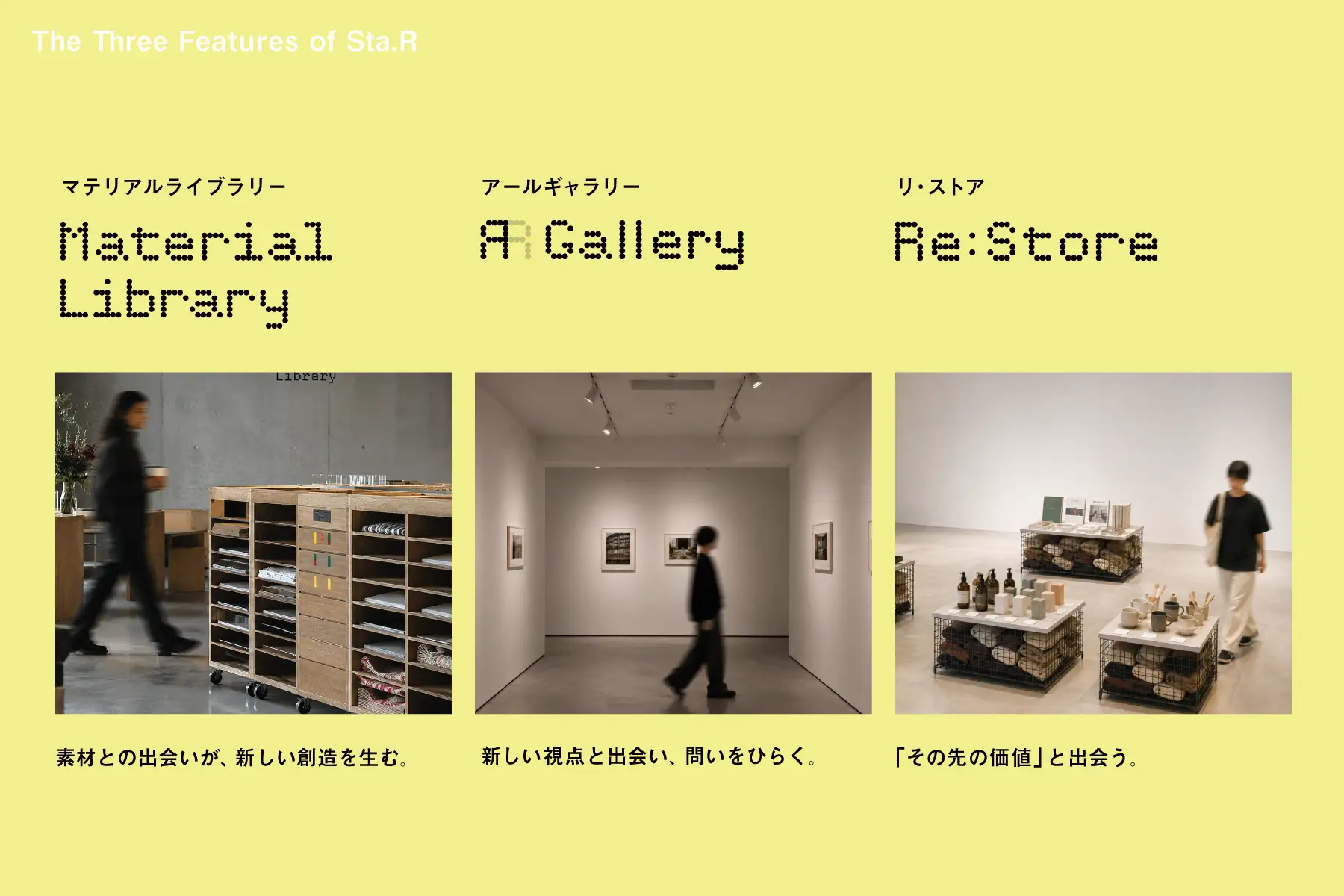
Sta.R permanently houses three facilities: the “Material Library,” which gathers local waste materials and circular materials; “Я gallery,” a gallery where visitors can view and exhibit artworks on the theme of circularity; and “Re:store,” a shop featuring local circular goods, items, and artworks. Going forward, Sta.R will also hold talk events, school programs, workshops where visitors can enjoy upcycling and repairing waste materials, art festivals, and more, themed around circularity, sustainability, culture and the arts, design, and creativity.
Material Library
Material Library is a library of materials that gathers circular materials such as local waste and bio based or recycled materials. It collects unique materials that can be used for upcycling, craft projects, independent research, and more. Through encounters with materials that blur the line between waste and resources and spark creative inspiration, Material Library generates a new circulation of resources and excitement within the community.
Я gallery
Я gallery is a gallery that offers perspectives for “rethinking things,” such as Rethink, Research, Respond, React, and Reveal, in contrast to the practice of the “R” that generates circularity championed by Material Library, such as Reuse, Remake, Recycle, Respect, and Regenerate. The reversed “R,” written as “Я,” carries the meaning of looking anew at existing values, social systems, and relationships with materials, and discovering new possibilities. Realizing a circular society requires not only actually circulating resources but also questioning the ideas and values that underlie them. Through art, design, and research, Я gallery will develop programs that critically examine existing concepts and generate new perspectives and dialogue in society.
Re:store
Re:store carries circular goods, upcycled products, and artworks made in various areas, primarily within the city of Yokohama. It offers creative items that make it easy and enjoyable to bring a circular lifestyle into everyday life.
Comments on the Opening of Sta.R
Artiql Inc. Representative: Yu Kato
I am very glad that we have been able to open ‘Sta.R’ together with everyone at Route Design, who have been creating a new creative scene in Yokohama based at ‘PILE’ in Tennocho, with the support of many people including the City of Yokohama and Sagami Railway. In order to realize a circular society in which every resource and every person is valued, I have long felt that what matters is each person’s creativity to change their perspective and use what already exists to move reality in a better direction, places where diverse people can meet and rediscover each other’s value, and the power of a culture in which these values spread beyond economic rationality. In that sense, Sta.R, built on the concept of creativity, circularity, and culture, is truly a place that embodies the future we want to realize. Going forward, I am really looking forward to working together with everyone, both inside and outside the region, to create places, communities, and a city where people and people, people and nature, and the present and the future are connected through art and upcycling, and where kindness and excitement continue to circulate.
Route Design LLC Representative: Yoshio Tsuda
It was in 2023 that we launched the creator coworking space ‘PILE’ on the Tennocho Station side of Seiten qlay. Since opening, artists and creators centered in Yokohama have gathered there, and through their daily trial and error, numerous creative projects and communities have been nurtured.
This time, together with everyone at Artiql, we have realized a new facility, ‘Sta.R,’ at the neighboring Hoshikawa Station, featuring ‘Material Library,’ where visitors can encounter materials and products that stimulate creativity, and ‘Я gallery,’ which showcases works and ideas. I feel that this has added the new meaning of a fresh flow of creativity to the line connecting these two stations.
We hope that PILE and Sta.R will not only become a source of new forms of expression and encounters for creators, but will also grow into a ‘departure and arrival point of creativity’ that brings new perspectives and discoveries into the daily lives of local residents through encounters with materials, products, and art.
Ondesign Partners Co., Ltd. Representative: Osamu Nishida
Sta.R, located along the Sotetsu Line’s Seiten qlay, which connects Yokohama’s coastal area with its inland area, is a hub for thinking about the circular society of the future. This place, named a station, is a mixed use facility that encompasses and puts into practice exchange, learning, exhibition, production, and encounters alike. I want to work together to build the future of Sta.R, a crossing point that unravels the circulation of society, connects Yokohama’s coast and suburbs, and sparks new creation.
Details
Sta.R official website: https://stationr.yokohama/ (in Japanese)
[Related page] City of Yokohama (in Japanese)
[Related page] PR Times (in Japanese)
The documentary film “The Repair Cafe,” the first documentary produced by “IDEAS FOR GOOD,” the media platform we operate, ranked first in number of screenings among 88 works in the screening ranking for the first half of 2026 by “cinemo,” a community screening platform. According to cinemo, the film also ranked fifth in audience attendance during the same period.
The film is a 30 minute short documentary set in Amsterdam, Netherlands, the birthplace of “Repair Cafe,” an initiative in which local volunteers repair broken items for free rather than having people replace them, in a society premised on mass production and mass consumption. By closely following the activities on the ground and the communication that arose from them, the film reconsiders the relationship between people and the objects around them.
After screenings, many cases were seen in which participants also held “repair events,” bringing in broken household appliances, torn clothing, broken dishware, and other items to repair. The film was selected not only to be watched, but as a work that encourages interaction among participants and connects challenges with ideas.
We will continue to advance efforts to resolve social issues and connect people with one another through documentaries and media.
[Reference page] cinemo「Top 10 announced! cinemo’s popular film ranking for the first half of 2026」(in Japanese)
[Related page] cinemo「Film ‘The Repair Cafe’ information」(in Japanese)
[Related site] Documentary Film “The Repair Cafe” (in Japanese)
IDEAS FOR GOOD, the web magazine we operate that gathers ideas for making society “even” better, renewed its website in June 2026.
The Background and Purpose of the Renewal
To make society an “even” more wonderful place. IDEAS FOR GOOD is a web magazine launched in 2016 with this aspiration in mind. Until now, on themes such as climate change, circular economy, gender, human rights, local communities, education, and technology, we have communicated the efforts of companies, local governments, practitioners, and citizens confronting social issues around the world.
Amid the constant flow of news reporting problems such as wars, disasters, and scandals, what IDEAS FOR GOOD has shed light on is not only the issues themselves. It is the creative practices of people trying to change the future beyond those issues, the hope that is budding, however small yet surely, and the ideas that make you think, “I would like to see a world like this.”
We want to deliver inspiration to as many people as possible and create a trigger for their next action. Through our articles, we want to move society forward toward a better future. With such wishes, IDEAS FOR GOOD has delivered hopeful ideas and people’s voices for about ten years.
At the same time, today, the challenges surrounding us are complexly intertwined, including the climate crisis, social division, inequality, the wavering of democracy, and the rapid advance of AI. An effort that looks like hope to one person may leave anxiety or a sense of unease in another. What can be called “GOOD”? This is an era in which even that can no longer be determined as easily as before.
Furthermore, as generative AI and giant platforms greatly change the information environment, media are once again being asked what they should record, whose voices they should leave in society, and what kind of dialogue they should nurture. Precisely because this is an era in which vast amounts of information flow away, we believe there is meaning in carefully preserving the small voices in the corners of society, the trial and error accumulated in the field, and the words of people who take on challenges believing in the future.
There is no single right answer to these problems. That is precisely why IDEAS FOR GOOD will evolve into a medium that does not merely present solutions one way, but that thinks about the question “what kind of future do we want?” together with our readers, practitioners, companies, and local governments, engaging in dialogue and creating together.
In the crowdfunding campaign for “IDEAS FOR GOOD 2.0” carried out in 2025, we received support totaling 6,673,500 yen from 378 people. What we set out there was a new form of media that reweaves “crisis” into “hope” , and “division” into “connection.”
This website renewal is the first step in advancing from “journalism that shows solutions” to “journalism of questions” that stays close to each person’s truth, and from a medium for “reading” to a medium that thinks about and weaves the desired future together.
Three Features of the New Site
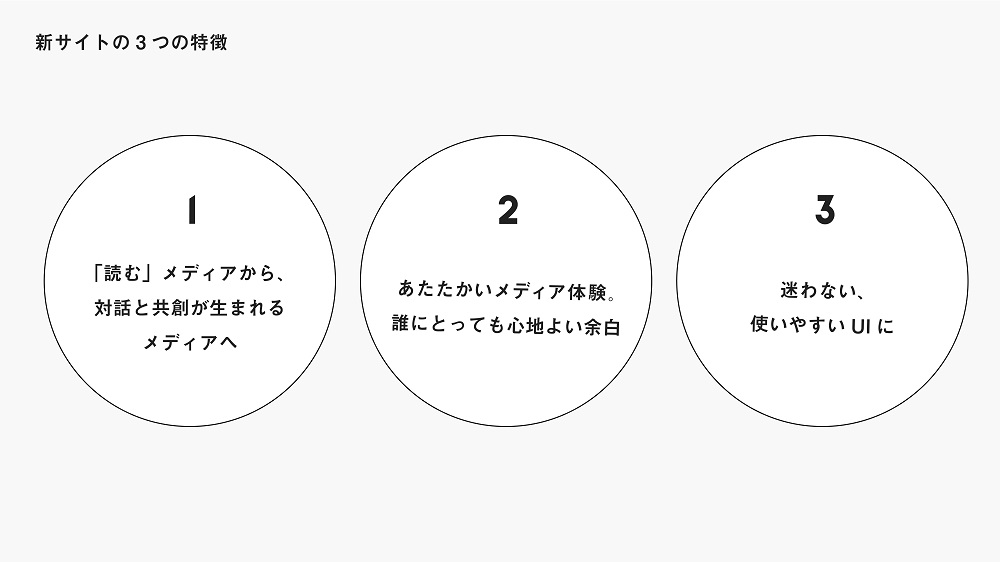
1. From a Medium for “Reading” to a Medium Where Dialogue and Collaborative Creation Arise
The new IDEAS FOR GOOD is not a place where things end once you have read an article. Through events, workshops, podcasts, reporting projects, communities, and more, we will cultivate places where readers, companies, local governments, and practitioners meet and think together.
As an entry point, the top page adopts a structure that lets you switch between “READ” and “MEET.” Whether you want to read an article carefully, or you want to meet someone and take part in a place for dialogue or experience, you can naturally reach the content you need according to your mood and purpose at that moment.
There is a great distance between knowing about an issue and actually creating change. In order to close that distance even a little, IDEAS FOR GOOD aims to be like a “public square” where people in different positions engage in dialogue that leads to the next practice, not just a place that delivers information.
2. A Warm Media Experience. Comfortable White Space for Everyone
Organizing information neatly so that the power of articles, photographs, and each individual word can be received directly. What supports this is a minimal layout with generous white space.
The base tone is the same monochrome as before, but we have slightly softened the overly strong contrast and used, for the text and color areas, a somewhat pale black rather than jet black. The background is laid not with a stark pure white but with a faint cream color. By giving warmth to the depths of the screen, we valued a comfort in which everyone, regardless of age, position, or the timing of their reading, can read, think, and pause at their own pace without being rushed, along with an inclusive atmosphere that leaves no one behind.
3. An Intuitive, Easy to Use UI
“The content is good but hard to read.” “I get lost about where to look.” Starting from the readers’ voices we heard for this renewal, we redesigned the paths to information from scratch.
We organized the information hierarchy simply, into navigation where you intuitively understand what is where. So that both first time visitors and those who have long been familiar with us can reach the article or experience they are looking for without getting lost. Meeting what you want by the shortest route is not only comfortable but also reduces unnecessary communication and loading, which in turn helps curb the load on servers and the CO2 emissions that accompany communication. We aimed for a UI that achieves both ease of use and kindness to the planet.
The Logo Renewal
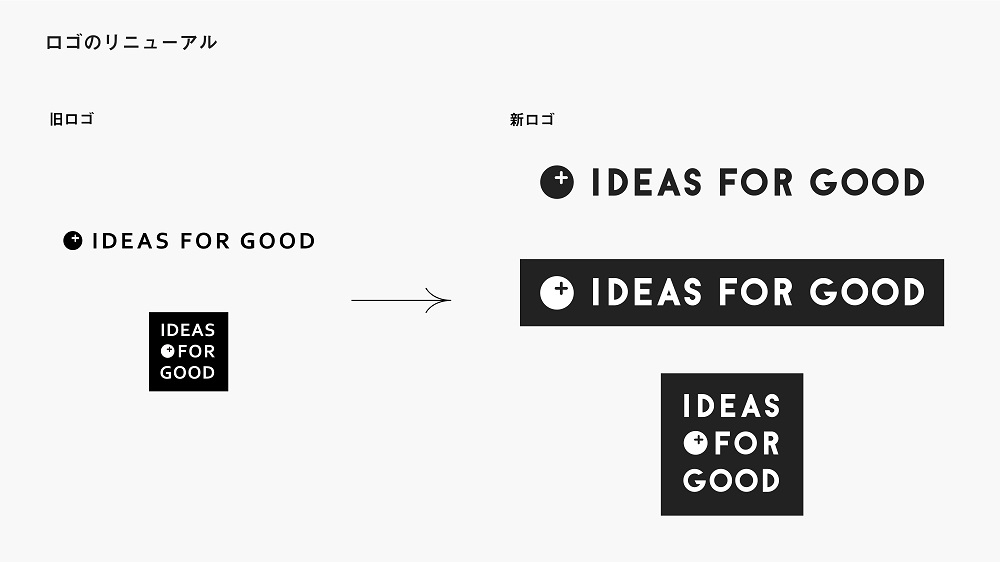
This time, we also updated the IDEAS FOR GOOD logo into a form that is easier to remember and conveys the character of IDEAS FOR GOOD.
While inheriting the previous elements, we organized the relationship between the symbol and the logotype, enhancing legibility and presence. We refined it into an iconic form that stays in memory at a glance, and made it an original shape that can be used consistently in various settings, from social media icons to large visuals.
What we put into it was the desire to convey, naturally and also visually, our stance as “a medium heading toward positive change.” Small ideas move society forward little by little. We aimed for a logo that conveys that stance at a glance.
On the Occasion of the Renewal
IDEAS FOR GOOD Editor in Chief: Erika Tomiyama
The work of creating articles is sometimes mysterious. Right after publishing, we can hardly see who is reading, or where. And yet, years later, people sometimes speak to us: “I have been reading since I was a student,” “An IDEAS article was what led me to actually visit that place,” “That article became the occasion for me to rethink my own work,” “I tried out an idea introduced in the article in my own community, too.”
A single article does not immediately change society. But it can leave a small sense of unease or curiosity in someone, and through that person’s choices and encounters, reach unexpected places. I believe the words the editorial team delivers take on a different meaning within a reader’s life and grow into the next question or practice.
With this renewal, we wanted to make such hard to see back and forth a little more tangible. An encounter with an article leads to a dialogue with someone. Dialogue becomes an occasion to put your own question into words. And that question leads to a small action in each person’s place.
Going forward, while delivering practices from around the world, IDEAS FOR GOOD hopes to remain a medium where readers can meet their own questions and find their next step in each of their places.
Artiql Inc. Chief Design Officer: Yuko Nagano
What we spent the most time on was neither color nor form, but “listening.”
Before design, this renewal began by first listening carefully to twelve readers and practitioners, one by one. That was the very start of a project that took more than a year.
What we listened to was not only about usability. When do they look for information, what do they get lost about, what kind of articles move their hearts? What kind of presence is IDEAS FOR GOOD in that person’s everyday life? Overlapping this with my own feelings as someone who was once a reader myself, we redid the design with people at the center.
What we aimed for was being able to meet what you want without getting lost. And also to happen upon unexpected ideas and opportunities, to encounter questions, and to think. So that both come true, we have redrawn the paths to information from scratch. A design that does not let you get lost is comfortable, and at the same time it reduces unnecessary communication and loading, which helps curb server load and CO2 emissions. Ease of use and kindness to the planet are not separate things.
We also fine tuned the design tone to stay close to that comfort. The base tone is the same monochrome as before, but for the text and color areas we chose a somewhat pale black rather than jet black, and for the background a cream tinted white rather than a stark white. So that a quiet warmth dwells across the whole screen.
Design is not merely the work of arranging appearances. That everyone can use it comfortably, and that it does not burden the planet. As that responsibility, we will continue to use renewable energy in our operations and to regularly estimate CO2 emissions, and we will work to improve accessibility, with JIS X 8341-3:2016, which conforms to WCAG 2.0, as our quality standard.
May this new IDEAS FOR GOOD reach many more people, be read more deeply, and become, beyond just reading, an occasion to meet and gather with others. And beyond that, may we come to be able to hold hope for our own future once again. Through design, I hope we can cultivate such a place.
Future Developments
1. A Medium Where You Can Participate in the Questions
Going forward, IDEAS FOR GOOD will increasingly expand opportunities as a “medium where you can participate in the questions,” one that does not end with just reading articles.
Through screenings of our original documentary film “Repair Cafe,” editorial meetings and events where readers and the editorial team bring their questions together, and “Experience for Good,” which visits the sites of social issues in Japan and abroad, we will open up places to think about society and the future together, engage in dialogue, and connect to the next action.
Most recently, on July 9, 2026, in Akasaka, Tokyo, we held “IDEAS After Talk Vol.1,” where readers and the editorial team talked with articles as their clues. The theme of the first session was the space between “working” and “living.” Using articles dealing with a 2.5 day weekend and a four day work week as an entry point, participants and the editorial team brought together the questions found in how we work and in daily life.
Not to find the right answer, but to touch different experiences and values while looking again, from a slightly different angle, at your own choices and at how society should be from here on. We will cultivate such time in various places going forward.
2. Moving Between Theory and Practice (the Field)
At “IDEAS FOR GOOD Business Design Lab,” a collaborative creation type business development lab with companies and local governments, we will connect the global cases, ideas, and voices from the field that IDEAS FOR GOOD has cultivated as a medium to practice in business and in local communities.
For issues surrounding sustainability, the circular economy, community development, and more, we accompany our partners through research, workshops, site visits and fieldwork, talent development, business development, and communication design. Rather than ending with merely holding up ideals and concepts, we test in the field, learn, sometimes pause, and think again. Moving back and forth between the ideal and practice, we will give shape, together with you, to the change that makes society “even” better.
3. Continuing to Preserve Voices for the Future
Precisely because this is an era in which AI and platforms are greatly changing the information environment, IDEAS FOR GOOD will carefully record the small voices in the corners of society, the not yet widely known challenges, and the wisdom rooted in local communities, and hand them on to the next generation.
The future is not something that someone will complete for us. It is something that takes shape little by little as the experiences, imagination, questions, and trial and error of diverse people overlap. Going forward, along with delivering hopeful ideas, IDEAS FOR GOOD will cultivate the places and mechanisms for thinking about the future from each person’s position, engaging in dialogue, and moving into action.
[Related site] IDEAS FOR GOOD (in Japanese)
Harch Inc. (head office: Minato-ku, Tokyo; Representative Director: Yu Kato) and Future Sessions Inc. (head office: Minato-ku, Tokyo; Representative Directors: Hideyuki Arifuku and Dainichiro Kakei) will merge as of June 30, 2026, and make a fresh start as Artiql Inc.
Background to the Merger
With “Rewrite Our Futures” as its mission, Harch Inc. has operated digital media in the sustainability and circular economy fields (such as “IDEAS FOR GOOD”) and developed a sustainability and circular economy support business for companies and local governments.
Future Sessions Inc. has advanced many collaborative creation projects together with companies and local governments, such as community development, citizen collaboration, talent development, the use of sports, and future creation, through “Future Sessions,” its creative spaces for dialogue, toward the realization of social innovation.
The two companies have built up collaboration over a long period in the fields of sustainability and the circular economy. The communication and engagement through media that Harch has cultivated, and the project design and implementation support that Future Sessions has. These have become ever clearer as a complementary relationship of “creating empathy through media and providing a process of collaborative creation toward the realization of a better society” through our day to day projects. In order to integrate the client work that had also been carried out at Harch with Future Sessions’ business, and to further strengthen the value we provide in the sustainability and circular economy fields, where growth is expected, the two companies have decided to merge.
What We Aim for After Integration
After the merger, the company name will become Artiql Inc., and we will transition to a structure that organically links three business divisions: Product (media), Process (execution of collaborative creation projects), and Place (operation of bases and spaces). To practice, together, the transition to a sustainable future through “empathy” and “collaborative creation.” With this aspiration, we will continue to build deep relationships with our customers and partners.
Overview of the Merger
- Merger method: Absorption merger (surviving company: Harch Inc. / dissolving company: Future Sessions Inc.)
- Effective date of the merger: June 30, 2026
- Company name after the merger: Artiql Inc. *Trademark registration pending
- Head office location: 3F-302 Motoakasaka East 1-7-18 Motoakasaka, Minato-ku,Tokyo 107-0051 (no change)
- Succession of business: The rights and obligations of the dissolving company will be comprehensively succeeded to by the surviving company as of the effective date of the merger.
Management Structure After Integration
On and after the effective date of the merger (June 30, 2026), the management structure of Artiql Inc. will be as follows.
- Representative Directors: Yu Kato / Hideyuki Arifuku / Dainichiro Kakei
- Directors: Takahiro Amano / Yuko Nagano / Yutaka Hara
To Our Business Partners
In connection with the merger, the surviving company’s name will be changed to Artiql Inc. Transactions based on existing contracts and orders will be succeeded to by the surviving company as of the effective date of the merger, and this does not change the content of our services itself. For business partners who need to complete procedures such as changing the name on a contract, we will send separate guidance.
Inquiries Regarding This Matter
If you have any questions or concerns regarding this matter, please contact us through the inquiry forms below.
Future Sessions Inc. inquiry form (in Japanese)